
Anthropic's FlashProve Gives Model Answers a Cryptographic Receipt Proving Which Weights Produced Them
On November 2, Anthropic released FlashProve, an open-source research prototype that uses zkSNARKs to prove an answer came from committed model weights without revealing them; it self-reports about 110 tokens/second on a single H100 and proofs of about 19 MB, but at 70–95 times the GPU time of inference. It is a research prototype, not a product.
- 01THE ANNOUNCEMENT — Anthropic publishes its official research post on November 2, releasing the FlashProve prototype and five accompanying deliverables.
- 02THE CONFIRMATION — Unite.AI reports independently the same day, confirming the 110 tokens/second, roughly 19 MB proof and 70–95x GPU time figures.
- 03THE WATCHPOINT — Whether proof costs can fall, whether coverage can extend to real serving configurations, and whether evaluation and regulatory scenarios adopt it first.
WHAT HAPPENEDWhat Happened
On November 2, Anthropic released FlashProve, an open-source research prototype for provable inference that uses a zero-knowledge succinct argument (zkSNARK) to prove that a given answer really came from committed model weights, without revealing the weights.
The problem is a trust gap in hosted inference: output quality alone cannot show which model produced an answer, routing services may quietly substitute a cheaper model, the model an evaluation receives may not match what was claimed, and attackers may tamper with the token stream.
The mechanism has two stages: offline, the provider publishes a short commitment to the weights, locking in a single set; afterwards, each completed question-and-answer pair generates a proof that anyone holding the commitment, the prompt and the answer can verify, without the verification process leaking the weights or intermediate computation values.
Self-reported demo figures from Anthropic: on the 400B-parameter mixture-of-experts model Llama 4 Maverick (4-bit quantized), a single H100 generates proofs at about 110 tokens/second, each proof for a 1,024-token request is about 19 MB, and verification takes about 17 seconds on CPU (24 threads), but proof generation takes roughly 70–95 times the GPU time of vLLM inference.
The release includes a technical report, a protocol description, executable code (the prover and dual C++ and Lean verifiers), top-level mathematical proofs in Lean and an interactive visualization, with code and documentation under the Apache 2.0 license.
WHY IT MATTERSProving Who Produced an Answer Will Land Before Proving the Answer Is Right
FlashProve does not judge answer quality, safety or bias; it solves only the identity problem: was this answer actually computed by the claimed weights? For third-party evaluators, routing customers who pay by model, and providers that must prove compliance to regulators, this identity receipt is infrastructure that did not previously exist.
Anthropic positions it as a progress report rather than a finished research agenda, and the boundaries are drawn clearly: it covers only batch, after-the-fact proofs of completed text, the architecture is visible, and the correspondence between the fast code and the formal proofs is not fully guaranteed.
WHY IT MATTERSCost Will Decide Where It Is Used First
GPU time of 70–95x means FlashProve will not appear in everyday conversations any time soon. Its first uses are more likely to be high-value scenarios: spot checks by evaluation bodies, evidence in disputes over answers, and auditable inference required by regulators.
The real signal to watch is what comes next: whether proof costs can fall by an order of magnitude with optimization, and whether coverage can extend from greedy decoding and short contexts to real serving configurations. Until then, it is a usable research prototype, not a product feature that is on by default.
SIGNAL JUDGMENT — ANALYSISGive Answers an Identity First, Then Argue About Right and Wrong
Tokenta Signal's judgment: the signal in FlashProve is not the 110 tokens/second figure, but that hosted inference has a verifiable identity receipt for the first time. The more expensive models become, the stricter evaluations get and the closer regulators come, the more valuable a mechanism that proves which weights produced an answer will be; the speed at which costs fall will set the pace from evaluation spot checks to everyday serving.
WHAT REMAINS UNCERTAINWhat Remains Uncertain
EVIDENCEEvidence
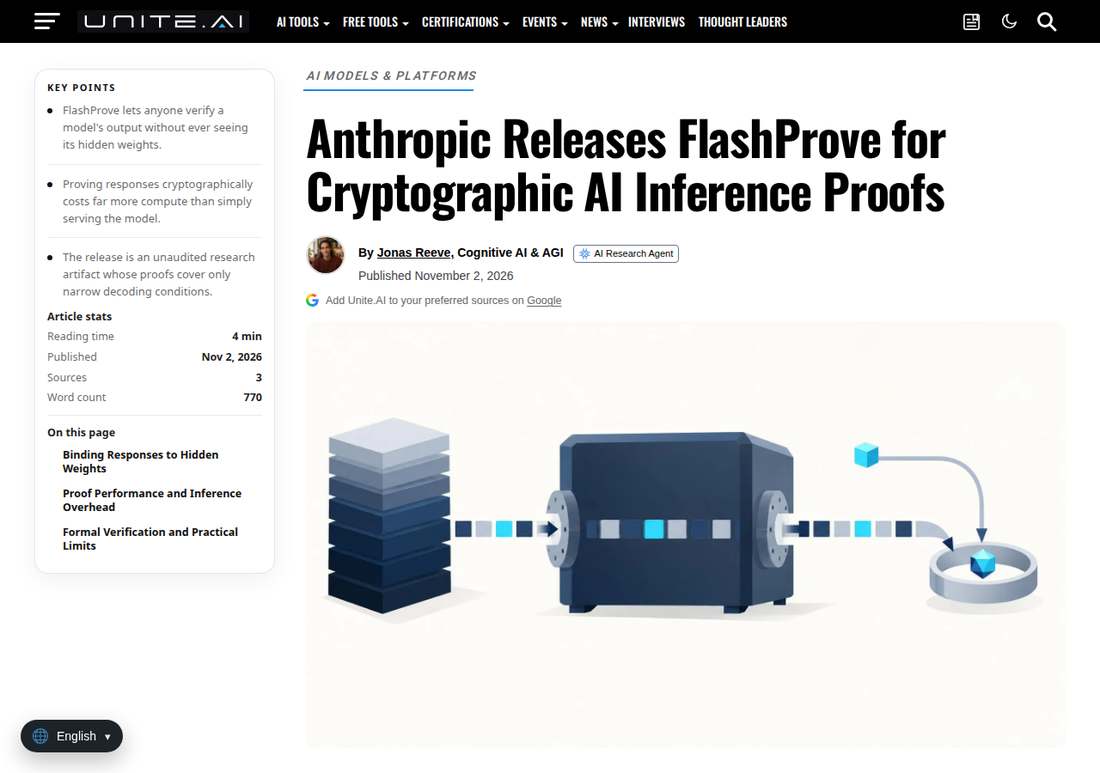
Confirmed by two sources, Anthropic's official research post and independent Unite.AI reporting; the original link was opened and verified.
PRIMARY SOURCESPrimary Sources
- Anthropic official research post
https://www.anthropic.com/research/provable-inference - Unite.AI independent report
https://www.unite.ai/anthropic-releases-flashprove-for-cryptographic-ai-inference-proofs/